Why does your child read slowly, get letters mixed up or tire quickly when learning?
· updated
Doing
homework takes a long time, they read slowly, get their letters mixed up and
tire quickly. Sometimes it can feel like the child is simply lazy or not
motivated enough.
But in most cases, the problem isn’t laziness. Often, the cause lies in a high
strain on the visual system, which a routine visual acuity test may not detect.
A child may be able to see the text on a blackboard or in a book clearly, but
reading, writing, drawing and other everyday activities can be much more
demanding on their eyes than we realise.
Eye motor skills needed for
reading
Reading isn’t just about recognising letters. The entire visual system needs to
work smoothly: the eyes need to move accurately, maintain focus and coordinate
with each other.
If any part of the system isn’t working optimally, problems may occur. A fixation disorder means the eye has
difficulty holding a steady gaze on a single word or letter. A child may skip
words or lose their place while reading because they cannot keep their eyes
focused on the text. Saccadic eye
movements are quick and precise eye movements, such as when moving from one
word to the next. If these movements aren’t precise, the child may skip words,
reread the same word several times or lose their place while reading. Smooth pursuit eye tracking disorder makes
it difficult for the eyes to follow a line of text or track a moving object
steadily. This can make reading tiring and slow, and it can also make tasks
like copying from the board into a notebook or following a ball during sports
more challenging. Vergence disorder
means that the eyes have difficulty working together to focus on the same
object. Normally, the eyes automatically move either towards each other
(convergence) or away from each other (divergence), depending on whether we are
looking at something near or far. Problems with vergence can cause double or
blurred vision, and may even lead to headaches or light sensitivity. Accommodation disorder is when the
eye’s focus doesn’t adjust smoothly between different distances. This makes
reading, writing, playing sports and drawing more difficult.
Eye motor skills and visual functions are essential for many everyday
activities, such as:
- reading and studying,
- drawing,
- copying from the board into a notebook,
- playing ball games,
- any activity that requires precision and coordination.
When a child's eyes don’t cooperate or struggle to focus, everyday activities
can become exhausting and frustrating, quickly lowering their motivation. Most
children like to read and study, and when the visual system is working
smoothly, these activities also become easier and more enjoyable.
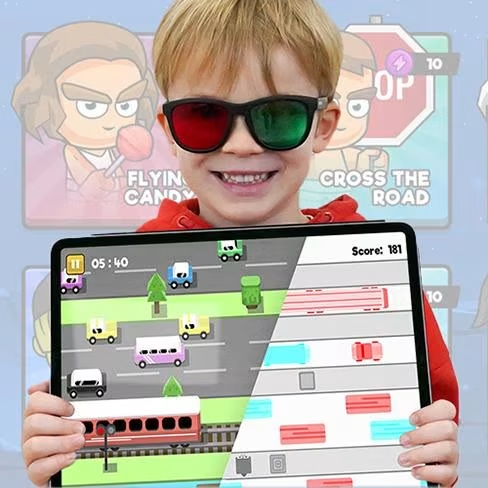
What is Eye Hero?
Eye Hero is a digital vision training programme designed to improve
children’s eye motor skills, coordination, vergence and accommodation. The
training programme is based on game-like exercises that keep children motivated
to practise regularly. In addition, an optometrist can keep track of the
child’s progress via a dedicated portal that records and tracks all
activities.
Structure of the training
- Duration: usually 6 months
- Frequency: ideally 5 times a week
- Session: 30 minutes in total, divided into two 15-minute sessions.
- Monitoring: weekly tests measure changes in eye coordination, visual acuity
and focusing ability.
- Motivation: the optometrist can monitor the child’s participation and
progress in real time
EyeHero helps to improve eye
accuracy and coordination, reduce visual fatigue, increase concentration and
make reading, writing, drawing and sports games easier and more enjoyable for
children.
When should a child have their eyes
examined? If the child:
- reads slowly,
- confuses letters or words,
- loses their place when reading,
- avoids reading,
- tires quickly when studying,
- complains of tired eyes or headaches.
The cause may be difficulties with visual functions. An optometrist can
evaluate the entire visual system, identify potential oculomotor, vergence, or
accommodation issues, and, if necessary, prescribe EyeHero vision
training.
Where to find help In case of such
complaints, we first recommend a thorough vision assessment at our Pro Optika
myopia clinics:
- Lõunakeskus, Tartu;
- Kaubamaja tn 4, Tallinn.
The initial consultation and eye exam can be carried out at any Pro Optika
store. An optometrist will help assess your child’s vision and refer them to
the appropriate service. With consistent training and the right diagnosis,
activities like reading, writing, drawing and everyday tasks can become much
easier and more enjoyable for your child. When the eyes work as they should,
learning often stops feeling overly difficult.